
What is the best art for a zen bedroom? (And what to avoid)
26 October 2026
Links marked (paid link) go to Amazon, and I earn a commission if you buy through them, at no extra cost to you. As an Amazon Associate I earn from qualifying purchases. Links to my own prints are just my shop.
By Yugen Print
The best art for a zen bedroom is one calm piece with plenty of empty paper: soft ink, muted colour and a single subject such as water, a branch or a lone figure. Hang it where you see it from the bed, light it warm and low, and leave the rest of the wall bare.
I founded Yugen Print, where I create sumi-e-inspired art prints, and I spend part of every year at our very traditional house in Japan. My bedrooms in Japan and New Zealand are both western style, with a low bed. The biggest difference is that the Japan house has large traditional wooden beams running across the ceiling. Most "zen bedroom" advice is about bedding and plants. This guide is only about the wall.
What makes art feel zen in a bedroom?
Art feels zen in a bedroom when most of the picture is empty, the contrast is soft and there is one clear subject for the eye to rest on. Ink on warm cream paper does this well, because the brushwork fades into the paper instead of stopping at a hard edge.
Japanese aesthetics has words for that empty paper. The designer Hara Kenya, art director of MUJI, describes yohaku as "empty space surrounding something" and ma as "a physical or temporal gap between things" (Japan House London, 2026). One section of his essay takes its heading from a line he quotes from the Honchō Gahō Taiden, an Edo-period painting manual: "Blank spaces are part of the picture, to be filled by the heart". The architect Mira Locher, writing about Zen gardens, puts it in a way that suits a bedroom too: yohaku no bi is "a device that allows the viewer's mind to settle down" (BBC Culture, 2022).
People are looking for this. Google's Keyword Planner puts "zen bedroom ideas" at roughly 700 searches a month in the US and about 200 in the UK (our own Keyword Planner check, October 2026). Pinterest's Fall 2024 trend report found searches for "zen house" up 405% and "Japanese futon bedroom" up 245% (June 2023 vs June 2024).
In our house in Japan, the one place I hang art is the tokonoma, the alcove where I keep a single scroll and change it over from time to time. One thing, on its own, with empty wall around it. That habit is the best rule I know for a bedroom wall too.
What size should art be in a zen bedroom?
Above a bed, aim for art about half to three-quarters of the mattress width. A queen mattress is 152 cm (60 in) wide, so that means roughly 76 to 114 cm of art, either one wide piece or a pair hung close together.
Most of my prints are portrait, in a 2:3 ratio, so one print on its own is narrower than people expect. A 24×36″ print is 61 cm (24 in) wide, which is about 40% of a queen mattress. In a slim frame it reaches about 66 cm, close to half the width of a 135 cm (53 in) US full or double. So for a full or double bed, one 24×36″ print works. For a queen or king, hang two 20×30″ prints side by side with a gap of about 7.5 cm (3 in), or choose one large print for the wall you face.
Keep the bottom of the frame 15 to 25 cm (6 to 10 in) above the headboard. My guide to what size wall art to hang above a bed or sofa has a full size chart for every bed width.
We have a super king bed, and for a bed that size a large 24×36″ print works well on the wall opposite the bed, so it's the first thing you see when you wake up. I prefer the opposite wall partly because I'd always worry about a frame falling on my head while I slept.
Where should art go in a zen bedroom?
The best wall for art in a zen bedroom is often the one you face from the bed, not the one behind it. You see that wall last thing at night and first thing in the morning, and nothing heavy hangs over your head.
There's a safety reason too, if you live somewhere with earthquakes. The Tokyo Fire Department found that in recent Japanese earthquakes, about 30 to 50% of people injured were hurt by furniture and objects falling, toppling or moving indoors (Tokyo Fire Department, PDF). New Zealand's National Emergency Management Agency says the same about art: hang heavy pictures and mirrors "away from beds, couches, and anywhere people sleep or sit" (NEMA).
Earthquakes are part of life in both the countries I call home. Wherever I hang art, I'd always use extra anti-fall hooks in case of an earthquake. If you do hang art above the bed, use a light frame with a plastic (acrylic or polystyrene) front instead of glass, on closed hooks that can't jump off the wall:
 puthiac 24×36″ solid oak frame with a polystyrene front (paid link). Light, glass-free, and sized for a 24×36″ print; use it without the mat.
 Quakehold! anti-fall picture hooks, 2 pack (4 hooks) (paid link). It's a latching hook that stops the wire lifting off, so a frame can't bounce off in shaking.
Which colours and subjects suit a zen bedroom?
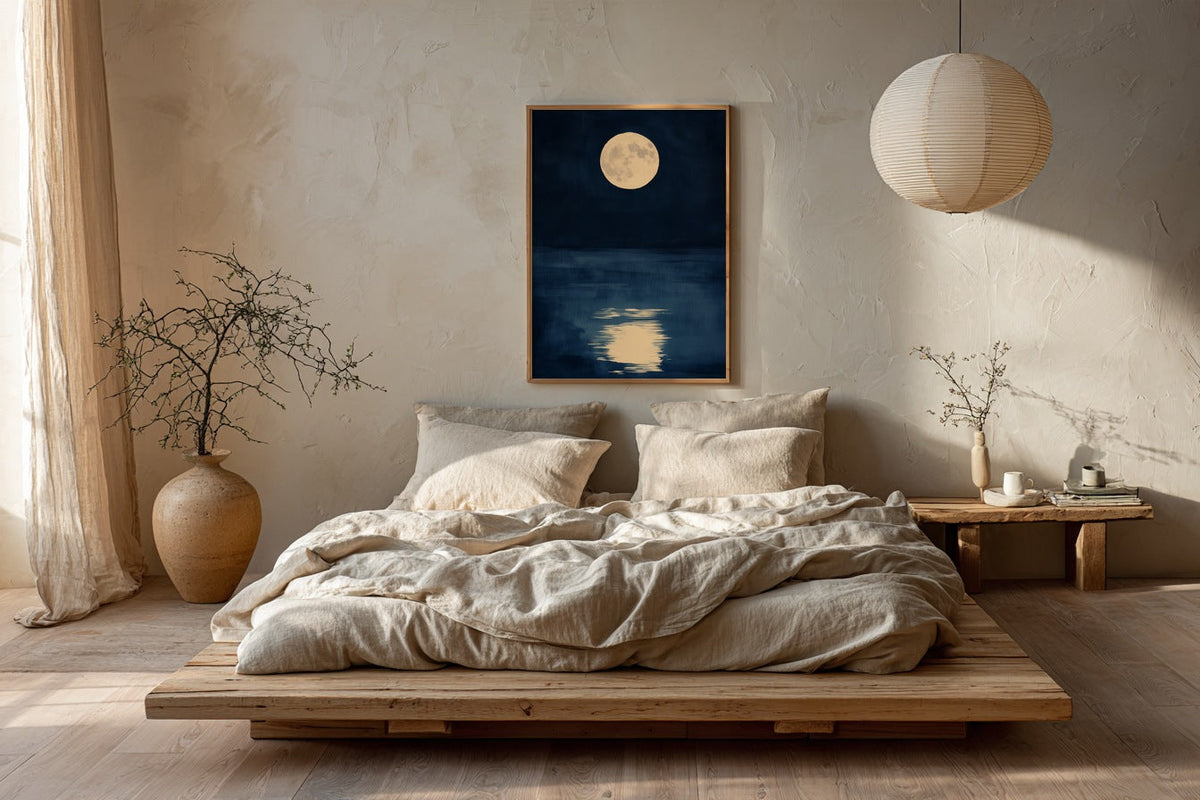
Soft black ink, grey wash, indigo and warm cream suit a zen bedroom best, with one natural subject: still water, the moon, a single branch or a lone figure. Low contrast and a slow subject help a room feel settled at night.
Water is the subject I come back to. I often see grey herons standing in the river, completely still, and that kind of image is what I'd want to look at before sleep: something that is barely moving. Moonlit water, mist and bare branches work the same way.
Colour matters more in a bedroom than in a living room, because you see it in low light. Indigo and charcoal go darker and softer under a lamp, and warm cream paper reads as gentle, where bright white paper can look stark at night. If your walls are dark, my guide to the dark Japandi bedroom covers which ink colours hold up on a deep wall.
What should you avoid in zen bedroom art?
Avoid busy gallery walls, bright saturated colour, harsh black-on-white contrast, heavy glass over the bed and cool, bright lights aimed at the art. Each one gives the eye something to work at when you want it to rest.
These are the mistakes I see most often:
- A gallery wall over the bed. Six frames means six things to look at. One large piece, or a matched pair, does the job with less.
- Glass over the pillows. Glass is heavier than plastic and can shatter. In a quake zone, that matters more than reflections.
- High-energy subjects. Crashing waves, red and gold, crowded street scenes and big text prints are lovely in a hallway. In a bedroom they keep you looking.
- Bright white mounts and frames on a warm wall. They pull the eye to the frame instead of the picture. Oak, walnut or black usually sits better with ink work.
- A ceiling downlight on the art. It's the brightest, coolest light in the room, and it's the one you'll switch off first.
How should you light art in a zen bedroom?
Light bedroom art with a warm, dim lamp, around 2700K, placed low or to one side, instead of a bright overhead light. Warm light makes cream paper and ink look softer, and dim, warm light at night is kinder to sleep.
Harvard Health notes that even dim light can affect melatonin, and that "a mere eight lux", brighter than a night light and less than most table lamps, has an effect (Harvard Health, reviewed July 2024). In a Harvard study it describes, 6.5 hours of blue light suppressed melatonin for about twice as long as green light of the same brightness, and shifted body clocks by 3 hours instead of 1.5. So keep the bedroom lights warm, and keep them low as bedtime gets closer.
A paper lamp is the simplest way to do this. The washi spreads the light so there's no hot spot on the art.
 Adesso Orb large rice paper pendant, 24 in, plug-in cord (paid link). A plug-in rice-paper shade, so no electrician needed.
 Amazon Basics soft white 2700K dimmable LED bulbs, 6 pack (paid link). Warm and dimmable, for lamps near the bed. These are US E26 fittings, so UK readers will need E27 or B22 bulbs instead.
I keep my own bedroom dark at night, but if you like a soft light, either of these is a good place to start. My guide to Akari lamps and paper lanterns goes through more options.
Which Yugen Print pieces suit a zen bedroom?
The pieces I'd choose for a bedroom are mostly empty paper with one slow subject: a figure resting by water, a moon, a single branch. They start at US$34.99 for an 8×12″ on Fine Art paper and go up to US$129.99 for a 24×36″. The shop shows your own currency at checkout.
 The Still Point: a small figure rests on a low rock in open water, with cream paper spreading out on every side. Almost the whole print is empty, so it works as one large piece on the wall you face.
 Stillness: a figure sits at the edge of still water and looks out into mist, in soft ink wash on warm cream. It pairs well with The Still Point above a queen bed.
 Moon on Water: a full moon over dark water, laying a pale path of light across it, in deep indigo. It's the one for a darker bedroom.
 Snow Pine Branch: one pine branch in indigo and grey, its needles fading into mist, with most of the paper untouched. It suits a pale bedroom in winter.
 Lotus & Moon: a single lotus rising from ink-stained water under a full moon. It's the boldest of the five, so give it a whole wall.
Lotus & Moon is the one I'd hang in my own bedroom. I actually ordered one for myself, but my mother-in-law loved it so much that I gave it to her.
My framing guide explains which wood tones suit ink work.
About the prints
These are sumi-e-inspired digital designs, finished in the studio, not hand-painted originals. They come in five upright sizes from 8×12″ to 24×36″, on Matte or Fine Art (archival) paper, and the 8×12″ comes on Fine Art only.
Printed to order in 2–5 business days by JONDO, our print partner, then usually 2–5 business days to the US and 1–5 to the UK, with tracking.
Frequently asked questions
What is a zen bedroom? A zen bedroom is a calm, uncluttered bedroom based loosely on Japanese and Zen ideas: few objects, natural materials, soft light and plenty of empty space. On the walls, that usually means one calm piece of art, or none at all.
Should you hang art above the bed? You can, but keep it light. Use a slim frame with a plastic (acrylic or polystyrene) front instead of glass and closed hooks, especially in an earthquake zone. Many people find the wall facing the bed a better place for the main piece.
Is one large print or several small prints better for a zen bedroom? One large print, or a matched pair, is usually better. A group of small frames gives the eye too many things to look at in a room meant for rest.
What colours are best for zen bedroom art? Soft black ink, grey wash, indigo and warm cream work best, with very little bright colour. Low contrast reads as calmer, especially under lamplight.
Is the Japandi bedroom the same as a zen bedroom? They overlap. Japandi is a specific interior style that mixes Japanese and Scandinavian design, while "zen bedroom" is a looser idea about calm and simplicity. Art that suits one usually suits the other.
Related guides
- What size wall art should go above a bed or sofa?
- Dark Japandi bedroom: colours, ideas and the art that works
- Akari lamps and paper lanterns: how to light a Japandi room
- Shop the wabi-sabi bedroom: six Japandi essentials under $300
- What is wabi-sabi art? Meaning, examples and how to use it at home
Sources: Hara Kenya, "Looking behind Japanese concepts of 'empty space'", Japan House London, 2026 · Steve John Powell and Angeles Marin Cabello, "The meaning behind the Japanese Zen garden", BBC Culture, 12 Apr 2022 · Tokyo Fire Department, なぜ家具類の転倒・落下・移動防止対策が必要なの? (PDF) · NEMA, Earthquake: reduce the impacts · Harvard Health Publishing, "Blue light has a dark side", reviewed 24 Jul 2024 · Casper, mattress size comparison guide · Google Ads Keyword Planner (our own check, October 2026) · Pinterest, "The Pinterest Fall 2024 Trend Report"
About Yugen Print: Yugen Print's founder creates sumi-e-inspired Japandi and wabi-sabi art prints and splits her year between New Zealand and Japan. Yugen Print designs are sumi-e-inspired prints, not hand-painted originals, made to order on Matte or Fine Art (archival) paper. Read more about the studio.
As an Amazon Associate I earn from qualifying purchases. Links marked (paid link) go to Amazon.