Ikebana for beginners: what do you need, and how do you arrange your first stems?
28 October 2026
Links marked (paid link) go to Amazon, and I earn a commission if you buy through them, at no extra cost to you. As an Amazon Associate I earn from qualifying purchases. Links to my own prints are just my shop.
By Yugen Print · 28 October 2026
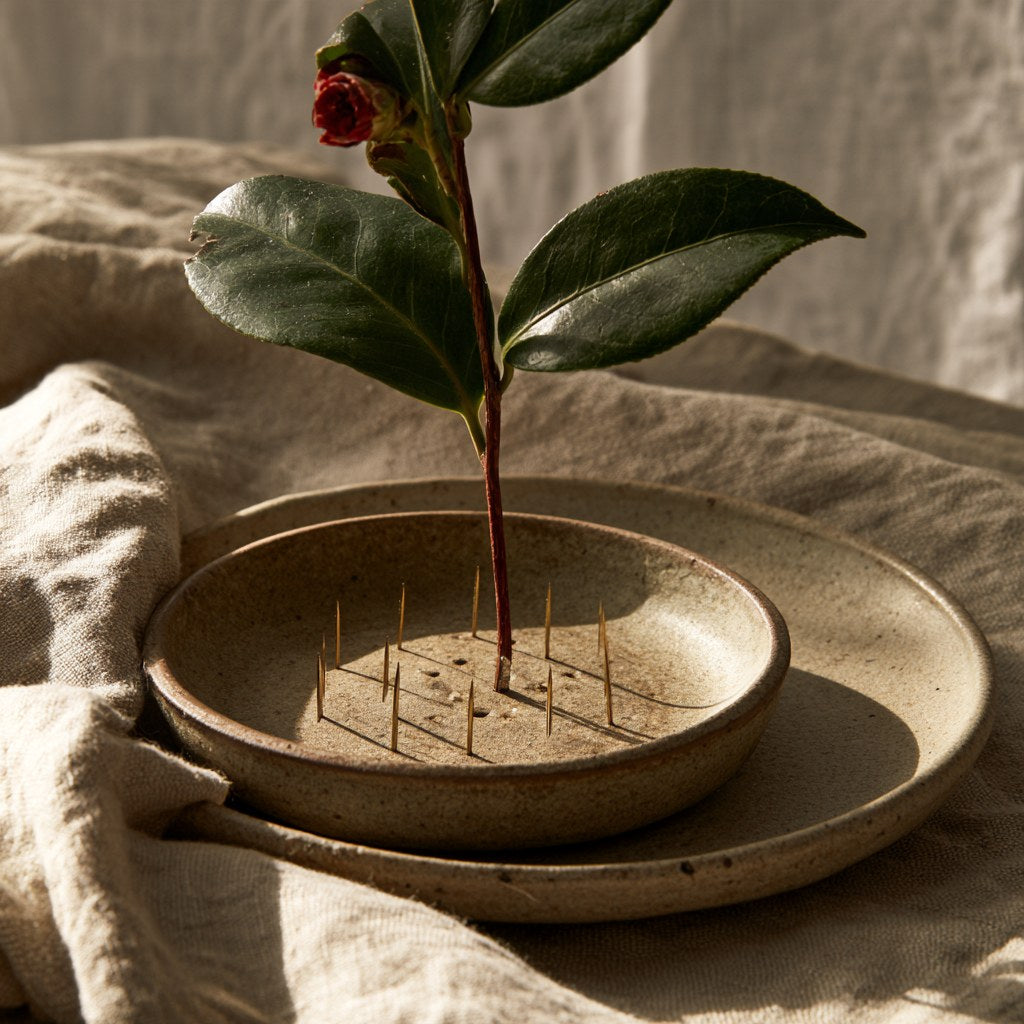
To start ikebana, you need a vase or a shallow bowl, a kenzan (a heavy pin holder that grips the stems), sharp scissors and three to five stems: one or two branches and a few flowers. Most beginner arrangements use three main lines of different heights, set at angles, with plenty of empty space between them.
I founded Yugen Print, where I create sumi-e-inspired art prints, and I spend part of every year at our very traditional house in Japan. I've never taken an ikebana lesson. What I do is put a branch in a vase when I've been cutting back the trees around the house. This guide is written for someone with no teacher and a free afternoon.
What is ikebana?
Ikebana is the Japanese art of arranging cut branches, leaves and flowers, usually with a few stems and a lot of empty space. The shape, the container and the place it stands all count as part of the work, along with the flowers.
The Japanese government's Web Japan factsheet describes ikebana as having a "500-year history", growing out of Buddhist flower offerings that arrived with Buddhism in the 6th century (Web Japan, PDF). The Ikenobo school, the oldest, dates its own story to 1462, when a Zen monk's diary records that Senkei Ikenobo, a priest at Rokkakudo temple in Kyoto, arranged flowers that "were highly praised by the people of Kyoto" (Ikenobo, History of Ikebana).
People outside Japan are curious about it. Google's Keyword Planner puts "ikebana" at roughly 40,000 searches a month in the US and about 6,600 in the UK (our own check, October 2026).
In our house in Japan, the tokonoma is the alcove where I keep a hanging scroll and change it over from time to time. Ikenobo traces the tokonoma back to the oshiita, a display shelf in Muromachi-period temples and houses where flower vases stood with paintings. Sometimes, after cutting back the trees around the property, I put a branch in a vase in the tokonoma with the scroll.
What do you need to start ikebana?
You need four things to start ikebana: a container, a kenzan or another way to hold stems, sharp scissors, and plant material. A heavy ceramic vase and a 6 cm round kenzan will cover most beginner arrangements.
A container. A shallow, wide bowl (a suiban) is the easiest place to begin, because the kenzan sits in the bottom and holds every stem where you put it. A tall vase suits a single branch. Our house in Japan came with a lot of traditional vases and other old things from the previous owner. In the kura, the traditional storehouse, I found a handwritten ikebana guidebook about a hundred years old, which was an amazing find. For a tall vase, a Tokoname piece is a good choice. Tokoname, near Nagoya, is one of Japan's Six Ancient Kilns and grew into the largest of them.
A kenzan. A kenzan is a heavy metal base covered in upright pins. You press each stem onto the pins at the angle you want, and the weight stops it tipping.
Scissors. Ikebana scissors (hasami) have short, thick blades with large round handles, so they cut a woody branch without crushing it. Kitchen scissors will crush a soft stem and blunt quickly on wood.
Plant material. One or two branches with a good line, and three to five flowers. Garden cuttings work as well as florist flowers.
Here's a simple starter kit:
 Tokoname-yaki Japanese ikebana vase (paid link). From Tokoname, one of Japan's Six Ancient Kilns. US$55.11 at the time of writing (October 2026).
 Wazakura 61 mm round kenzan, made in Japan (paid link). Handmade in Niigata, with 168 pins and a rubber pad. The base is a lead alloy, so wash your hands after handling it and keep it away from small children. US$29.99 at the time of writing (October 2026).
 Wazakura Koryu ikebana scissors, 165 mm, made in Japan (paid link). Yasugi steel, made in Sanjo, Niigata, with looped handles that suit beginners. US$45.99 at the time of writing (October 2026).
- YokohamaUSA ikebana suiban, 8.5″, made in Japan (paid link). About 22 cm across and 5 cm high, black ceramic round bowl. (The larger 27 cm moss-rim bowl was out of stock when this was checked.) US$78.95 at the time of writing (October 2026).
What's the difference between moribana and nageire?
Moribana is ikebana in a shallow bowl, with the stems held in a kenzan. Nageire, meaning "thrown in", is ikebana in a tall vase with no kenzan, where the stems lean against the rim and each other.
Moribana is the newer of the two. Unshin Ohara created it in the late 19th century, when colourful western flowers were starting to arrive in Japan, and designed wide, shallow containers to suit it (Ikebana International, Ohara). Ohara dates the school to 1895, when Unshin Ohara devised moribana, and he first showed it with colourful western flowers in 1897 (Ohara, Cleveland Museum of Art). Nageire is older. Web Japan says it grew out of chabana, the "tea flowers" of the 16th-century tea ceremony: "one or two flowers or branches in a small container".
| Moribana | Nageire | |
|---|---|---|
| Container | Shallow, wide bowl (suiban) | Tall, narrow vase |
| What holds the stems | Kenzan | The vase rim, a cut twig across the mouth, or the stems themselves |
| Easiest first material | One branch plus three to five flowers | One long branch, or a single flower |
| Good for | A low table, a sideboard under a print | A shelf, a tokonoma, a narrow hallway |
| Beginner difficulty | Easier, because the kenzan does the holding | Harder, because the stems slip |
If you only buy one container, buy a shallow bowl and a kenzan. Moribana forgives mistakes: you can pull a stem out and try again as often as you like.
How do you make a simple three-stem ikebana arrangement?
A simple three-stem arrangement uses a tall main line (shin), a medium line (soe) and a short line (hikae), each at a different angle. A common rule in Sogetsu classes makes shin about one and a half times the bowl's width plus its depth, soe three-quarters of shin, and hikae shorter again.
The Sogetsu school, founded in 1927 by Sofu Teshigahara, says ikebana can be made "anytime, anywhere, using any material" (Sogetsu, What is Sogetsu?), which is good news for a beginner with garden clippings. Its basic upright style is the one many teachers start with. Schools and teachers vary the numbers, so treat these as a starting point.
- Fill the bowl. Put the kenzan to one side of the bowl, leaving open water on the other side, and add water until the pins are just covered.
- Cut shin. For a bowl 25 cm across and 5 cm deep, shin is about 45 cm (1.5 × 30 cm). Use a branch. Push it straight onto the pins at the back of the kenzan, then tilt it slightly forward and to the left.
- Cut soe. Make it about three-quarters of shin, so about 34 cm. Use the same kind of branch. Place it at the front left and tilt it to about 45 degrees, leaning the same way as shin.
- Cut hikae. Make it about half to three-quarters of soe, so 17 to 25 cm. Use a flower. Place it at the front right and tilt it to about 75 degrees, leaning the opposite way.
- Fill in lightly. Add two or three shorter flowers or leaves (jushi) to hide the kenzan and link the three lines. Stop before the gaps disappear.
The measurements follow the basic upright moribana steps in this Sogetsu-trained teacher's primer. Some Sogetsu teachers make hikae three-quarters of soe instead of half; both are taught.
For shin, a garden branch with a clear bend works well. Anything left over from a prune will do.
How do you do one-stem ikebana?
One-stem ikebana is a single branch or flower in a vase, placed at an angle so its natural curve shows. It's the simplest form to try at home, and it comes from chabana, the tea-room style of one or two flowers.
Choose a stem with a clear line: a branch that bends, a leaf that turns, a flower that faces sideways. Cut it long enough to rise well clear of the vase, then lean it against the rim at the angle that shows the curve best. Strip any leaves that would sit below the water.
A single stem shows the empty space around it more than any other arrangement does. Sumi-e works the same way: most of the paper is left blank, so the eye goes to the one branch or flower that is there.
How do you keep ikebana flowers fresh?
To keep ikebana flowers fresh, recut the stems under water before arranging, change the water every day or two, and keep the arrangement out of direct sun and away from heaters or air conditioning.
Cutting under water is called mizukiri (水切り). Japan's Ministry of Agriculture, Forestry and Fisheries suggests cutting about 3 cm from the base of the stem under water, then leaving it in water for 5 to 10 minutes before moving it to the vase (MAFF, はじめよう、花のある暮らし). It also suggests a cool spot with soft light, such as an entrance hall. MAFF adds that thirsty flowers such as carnations and gypsophila can simply be cut in air if they look fresh.
How much mizukiri helps depends on the flower. In a study of Japanese flower retailers, 62% cut stems under water and 72% believed it helped. When the researchers tested seven dried-out cut flowers, cutting under water sped up recovery for chrysanthemum and gerbera, and made no significant difference to vase life for any of them (Horticultural Research (Japan), J-STAGE). So do it for flowers that are drooping, and don't worry if you skip it for fresh ones.
A kenzan also needs a quick rinse and dry after each use. If a pin bends, a kenzan straightener (a small metal tube) pushes it back.
Which art suits a room with ikebana?
Art that suits a room with ikebana has one plant subject and a lot of empty paper, so it echoes the arrangement without crowding it. Hang it beside or above the flowers and leave a hand's width of wall between the frame and the tallest stem.
The tokonoma is the model here: one scroll, sometimes one arrangement, and nothing else in the alcove. At home, a low sideboard or console with one print above it and a shallow bowl below does the same job. If the arrangement is tall and the print is portrait, offset them, so the branch doesn't cut across the picture.
These five prints all have one plant subject on mostly bare cream paper. They start at US$34.99 for an 8×12″ and go up to US$129.99 for a 24×36″, and Two Hydrangeas runs from US$39.99 to US$119.99 in its own sizes. The shop shows your own currency at checkout.
 Kakitsubata, Blue Iris at Water's Edge: a small stand of indigo iris with their stems reflected in still water. Kakitsubata (Iris laevigata) is the water iris Ogata Kōrin painted on the gold Irises screens, a National Treasure at the Nezu Museum in Tokyo. It pairs well with a moribana of iris leaves in a low bowl.
 Kakitsubata, Blue Iris by the Water: three iris blooms and two unopened buds above still water, with a faint reflection. The buds give it the same rising line as a shin branch.
 Two Hydrangeas: two indigo hydrangea heads, one above the other, in a slim vertical down the middle of the paper. It suits a narrow wall beside a nageire vase.
 The Blue Hour: one hydrangea stem in muted indigo and steel blue. It's the print version of one-stem ikebana.
 Cherry Blossom Branch: a single cherry branch leaning into a deep blue sky. The design began from a photo I took of the cherry tree outside our house in Japan. It's the boldest of the five, so keep the arrangement under it to plain green leaves or one bare branch.
My framing guide covers which wood tones suit ink work.
About the prints
These are sumi-e-inspired digital designs, finished in the studio, not hand-painted originals. Most prints come in five upright sizes from 8×12″ to 24×36″, on Matte or Fine Art (archival) paper, with the 8×12″ on Fine Art only. Two Hydrangeas comes in 12×16″, 18×24″ and 24×32″.
Printed to order in 2–5 business days by JONDO, our print partner, then usually 2–5 business days to the US and 1–5 to the UK, with tracking.
Frequently asked questions
Is ikebana hard for beginners?
Ikebana is easy to start and takes years to master. A shallow bowl, a kenzan and three stems are enough for a good first arrangement, and you can pull stems out and try again as often as you like.
Do you need a kenzan for ikebana?
You need a kenzan for moribana in a shallow bowl, but not for nageire in a tall vase or for one stem in a bottle. If you buy one tool, buy a kenzan about 6 cm across.
Can you use supermarket flowers for ikebana?
Yes. Supermarket and garden flowers both work. Pick one branch or stem with a strong line, and a few flowers of one kind, instead of a mixed bunch.
Which ikebana school should a beginner choose?
Ikenobo is the oldest and most classical, Ohara is known for moribana and landscape styles, and Sogetsu is the most free-form. Ikebana International, founded in 1956, has nearly 140 chapters in over 44 countries and areas, so a local chapter is a good way to find a teacher (Ikebana International).
What is the difference between ikebana and western flower arranging?
Western arrangements usually fill a vase with many flowers in a rounded shape. Ikebana uses fewer stems, values the empty space between them, and builds an uneven shape from lines of different heights.
Related guides
- What is wabi-sabi art? Meaning, examples and how to use it at home
- Japandi vs Scandinavian vs wabi-sabi: what's the difference?
- Ensō meaning: what the Zen circle symbolises, and how to hang one
- Japanese gift guide for people who love calm homes
- Shop the meditation room: Japanese sumi-e essentials
Sources: Web Japan (Ministry of Foreign Affairs of Japan), Ikebana factsheet (PDF) · Ikenobo, History of Ikebana · Sogetsu, What is Sogetsu? · Ikebana International, Ohara · Ikebana International, About us · Cleveland Museum of Art, The Art of Ikebana · Ikebana Dreaming, Moribana: a primer · MAFF, はじめよう、花のある暮らし · Ohara school, About · Questionnaires about handling of cut flowers and effects of cutting stems under water, Horticultural Research (Japan) 11(4), J-STAGE · Six Ancient Kilns, Tokoname · Nezu Museum, Irises by Ogata Kōrin · Google Ads Keyword Planner (our own check, October 2026)
About Yugen Print: Yugen Print's founder creates sumi-e-inspired Japandi and wabi-sabi art prints and splits her year between New Zealand and Japan. Yugen Print designs are sumi-e-inspired prints, not hand-painted originals, made to order by JONDO, our print partner. Read more about the studio.
As an Amazon Associate I earn from qualifying purchases. Links marked (paid link) go to Amazon.