What does the ensō mean? The Zen circle, and how to hang one
21 October 2026
Links marked (paid link) go to Amazon, and I earn a commission if you buy through them, at no extra cost to you. As an Amazon Associate I earn from qualifying purchases. Links to my own prints are just my shop.
By Yugen Print · 22 October 2026
An ensō is a circle brushed in one or two strokes of ink, and in Zen Buddhism it stands for enlightenment, emptiness and wholeness. Zen monks have brushed ensō for centuries, and part of the tradition is that each viewer reads the circle in their own way.
I founded Yugen Print, where I create sumi-e-inspired art prints, and three of my designs are built around the ensō's shape. In Japan I see circles like it everywhere, even on the sides of the trucks delivering food.
What is an ensō?
An ensō (円相, "circle form") is a circle drawn with an ink brush, usually in a single fluid stroke, as part of Zen practice. Once an ensō is brushed it's left as it is, so each circle records one moment and the person who drew it.
The tools are the same as for Japanese calligraphy: a brush, sumi ink and thin washi paper (Wikipedia). In Japanese it's also called ichi-ensō, "one circle".
Many of the best-known ensō were brushed by Zen monks in the Edo period. Tōrei Enji (1721–1792), the most important disciple of the Zen master Hakuin, made many versions. One in the Museum of Fine Arts, Houston is a hanging scroll 31.5 × 55.5 cm, with an inscription quoting the Buddha: "In heaven and earth, I alone am the Honored One." The museum's note calls the ensō "simultaneously full and empty", a symbol of wholeness.
People look this up a lot. Google's Keyword Planner shows "enso circle" averaging about 2,400 US searches a month, and "enso meaning" about 880 (Yugen Print's own keyword research, October 2026).
Circles are a favourite for logos in Japan too. Since the Edo period, merchants have put shop marks on their noren curtains, and marks built on 丸 (maru, circle) were popular. The Marui department store took its name from the belief that adding maru to a name brought good business. Once you start looking, you see circles on shop signs, packaging and delivery trucks.
Back home in New Zealand, the ensō often reminds me of the koru, the unfurling fern frond that Te Ara describes as a symbol of creation, with its coil suggesting a return to the origin. They come from very different traditions and mean different things, so I keep the koru as something I admire rather than something I use in my work.
What does the ensō symbolise?
The ensō symbolises enlightenment, emptiness, wholeness and the universe, and its meaning is traditionally left open to whoever is looking at it. Japanese dictionaries describe it as a picture of the mind's natural completeness.
The term is old. The Kotobank dictionary entry (in Japanese) says the ensō shows the enlightenment already present in each person's mind, and the earliest example it quotes comes from Dōgen's Shōbōgenzō, written between 1231 and 1253. Japanese Wikipedia adds two readings I like: the circle can be written 円窓, "round window", a window that reflects your own mind, and because a circle has no beginning, no end and no corner to catch on, it stands for a mind free of attachment.
The Louvre Abu Dhabi, which holds a tall Tōrei ensō of 90.1 × 28.4 cm, calls the circle the most important of the great Zen symbols, evoking "the perfection of Awakening".
What is the difference between an open and a closed ensō?
An open ensō has a gap where the brush lifted off, and a closed ensō joins up into a full ring. The open circle is usually read as incomplete and still moving, close to the wabi-sabi idea of beauty in imperfection, and the closed circle as completeness.
Both are traditional. Wikipedia notes that "some artists draw ensō with an opening in the circle, while others close the circle", and that an open circle allows "for movement and development". The Japanese tea shop CHANOYU (in Japanese) points out that an ensō is never a compass-perfect circle: it's often lopsided, with dry, broken patches where the ink ran out, and those flaws are read as a picture of a changing world.
My own designs sit at the closed end. In Enso Neko, a sleeping cat curls so tightly that its body makes an almost complete ring, and in Fugu Ensō a pufferfish has puffed itself up into a near circle.
If you want the wabi-sabi reading, look for an open circle with a visible dry-brush edge. My guide to wabi-sabi art explains what to look for.
Can you draw an ensō yourself?
Yes. Anyone can practise brushing an ensō with a sumi brush, ink and practice paper, and some people draw one every day as a short meditation. The aim is a single honest stroke, so the circle you keep is the one you drew, not the neatest one.
Wikipedia, citing Audrey Yoshiko Seo's book Ensō: Zen Circles of Enlightenment (Weatherhill, 2007), describes ensō drawing as a spiritual practice "one might perform as often as once per day". The wider practice of brushing ensō or calligraphy for self-realisation is called hitsuzendō.
A basic kit is a brush, ink and a stack of practice paper. Hanshi, the standard Japanese calligraphy practice sheet, is about 24 × 33 cm (9.5 × 13 in), big enough for a circle the width of your hand.
 Yasutomo Bokuju liquid sumi ink, 6 oz, for practice without grinding an ink stick (paid link)
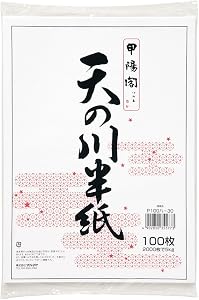 Maruai hanshi practice paper, 100 sheets, made in Japan, 9.5 × 13 in (paid link)

Is it respectful to hang an ensō at home?
Yes. Ensō scrolls are made to be hung and looked at, and in Japan the ensō is one of the classic hanging scrolls for tea rooms. Treat one as a spiritual symbol as well as a design: give it a calm spot and space of its own.
Zen monks made ensō for ordinary people. Sengai Gibon (1750–1837), who became abbot of Shōfukuji, Japan's oldest Zen monastery, in 1790, brushed many of his ink works at the request of local people, including children, according to Metropolis. He also had a sense of humour about the circle. One of his lopsided ensō carries the caption "What is this? I ate it with one bite", which turns it into a manjū bun (The Japan Times, 2018).
In a tea room, the hanging scroll in the tokonoma alcove is the first thing guests look at, and an ensō scroll is one of the classic choices, because tea ceremony grew out of Zen (Daruma3, in Japanese). CHANOYU gives the most common tea-room scroll size as 190 × 54.5 cm and says the scroll should suit the size of the alcove.
Two things to keep in mind. In Japan the ensō can also appear on Zen memorial tablets (Japanese Wikipedia), so it carries religious weight there. And a printed design like mine borrows only the ensō's shape. A real ensō is brushed by a person in one go, and I don't sell my prints as that.
My house in Japan has a tokonoma. It doesn't hold an ensō, but there is always a scroll in it, and I change it over from time to time.
How should you hang an ensō print?
Hang an ensō on its own, with plenty of bare wall around it, at the eye level of the person looking at it. In a meditation corner or beside a floor cushion, that means lower than usual, because people look at it sitting down.
The gallery rule puts the centre of a picture 145 to 152 cm (57 to 60 in) from the floor, but that's for standing viewers. The preparator at McMaster Museum of Art warns that the gallery standard "is intended for gallery viewers who are standing up, not at home" (McMaster Museum of Art). My guide to art sizes above beds and sofas has the full numbers.
A circle suits a square print. Enso Neko, Maru and Fugu Ensō all come in square sizes from 8×8″ up to 24×24″. A 20×20″ print (about 51 cm) in a plain wood frame works over a low chest or a meditation cushion, and an 8×8″ fits a shelf or a narrow wall.
To borrow the tea-room arrangement, put one object under the print, as a tokonoma pairs a scroll with flowers. I'd use my Tokoname vase with a single stem: the unglazed clay suits black ink.
 Tokoname-yaki Japanese ikebana vase (paid link)
 Homeforia 20×20 in natural oak frame, with a 16×16 in mat (paid link)
My framing guide explains which wood tones suit ink work, and Shop the Meditation Room has more ideas for a sitting corner.
Which Yugen Print designs use the ensō?
Three of my prints use the ensō's circle: two curled, sleeping cats and a puffed-up pufferfish. Prices start at US$29.99 for an 8×8″ on Matte paper and go up to US$129.99 for the largest Fine Art sizes (checked on 20 October 2026; the shop shows your own currency at checkout).
 Enso Neko: a cat curled so tightly in sleep that its body makes a near-perfect ring, ears up and whiskers loose, on warm cream. US$29.99 for 8×8″ on Matte, up to US$129.99 for 24×36″ on Fine Art.
 Maru: maru means "circle" in Japanese, and this cat curls into one with its eyes shut and fine ink whiskers, on warm cream paper. Same sizes and prices as Enso Neko.
 Fugu Ensō: a fully inflated pufferfish drawn as an ink circle with two startled eyes. It's the one with Sengai's sense of humour, and it suits a kitchen or reading nook. From US$29.99 for 8×10″ on Matte.
About the prints
These are sumi-e-inspired digital designs, finished in the studio, not hand-painted originals or brushed ensō. Two papers: Matte (smooth, 200 gsm) and Fine Art (archival; thick, softly textured, 285 gsm). Sizes run from 8×8″ to 24×36″, in upright, landscape and square formats, and the 8×12″ sizes and the 14×14″ to 20×20″ squares come on Fine Art only.
Printed to order in 2–5 business days by JONDO, our print partner, then usually 2–5 business days to the US and 1–5 to the UK, with tracking.
I chose the Fine Art paper after ordering test prints from five different printers. Its texture holds the grey wash in ink designs, and that shows on the dry, broken edge of a circle. My own test print from this printer took 10 days to reach me in Japan.
Frequently asked questions
Is a printed ensō a real ensō? Strictly, an ensō is a circle brushed by a person in one go, so a print is either a reproduction of one or a design inspired by one. Yugen Print's ensō designs are sumi-e-inspired digital designs that use the circle's shape.
What's the difference between an ensō and Sengai's "Circle, Triangle and Square"? An ensō is a single circle. Sengai's ink painting Circle, Triangle and Square (about 28.4 × 48.1 cm, Idemitsu Museum of Arts, Tokyo, according to the NEH) overlaps a circle, a triangle and a square, and is believed to show the three basic forms of the universe (Metropolis).
Does an ensō have to be black? Traditionally an ensō is brushed in black sumi ink on paper, so its tones run from deep black to a pale grey where the brush runs dry. Warm cream paper, like the ground on Enso Neko and Maru, softens that contrast.
Where should I hang an ensō? Anywhere you'll sit and look at it: a meditation corner, a bedroom wall or a reading nook. Hang it on its own, with bare wall around it, and lower than a standing gallery height if you'll mostly see it seated.
Related guides
- What is wabi-sabi art?
- Yūgen, ma and wabi-sabi: the Japanese aesthetics behind our prints
- Sumi-e vs ukiyo-e: two Japanese art styles
- What size wall art above a bed or sofa
- Shop the Meditation Room
Sources: Wikipedia, "Ensō" · Japanese Wikipedia, 円相 · Kotobank, 円相 (in Japanese) · Museum of Fine Arts, Houston, Tōrei Enji, Ensō · Louvre Abu Dhabi, Tōrei Enji, En-Sô · The Japan Times, "A master of Zen wisdom and dad jokes" (2 Oct 2018) · Metropolis, "Sengai: Zen and Humor" (2010) · CHANOYU, chagake guide (in Japanese) · Daruma3, ensō hanging scrolls (in Japanese) · McMaster Museum of Art, hanging tips · Audrey Yoshiko Seo, Ensō: Zen Circles of Enlightenment (Weatherhill, 2007), via Wikipedia · Google Ads Keyword Planner (US average monthly searches, retrieved 14 Oct 2026)
About Yugen Print: Yugen Print's founder creates sumi-e-inspired Japandi and wabi-sabi art prints and splits her year between New Zealand and Japan. Yugen Print designs are sumi-e-inspired prints, not hand-painted originals, made to order on Matte or Fine Art archival paper. Read more about the studio.
As an Amazon Associate I earn from qualifying purchases. Links marked (paid link) go to Amazon.