Japandi vs Scandinavian vs wabi-sabi: what's the difference?
25 October 2026
Links marked (paid link) go to Amazon, and I earn a commission if you buy through them, at no extra cost to you. As an Amazon Associate I earn from qualifying purchases. Links to my own prints are just my shop.
By Yugen Print · 25 October 2026
Japandi is a modern interior style that mixes Japanese and Scandinavian design: low, natural-wood furniture, warm neutrals and very little clutter. Scandinavian design is the light, useful Nordic modernism that became famous in the 1950s. Wabi-sabi is much older and is a way of seeing, not a decorating style: the Japanese sense that worn, imperfect and passing things can be beautiful.
I founded Yugen Print, where I create sumi-e-inspired art prints. I live in New Zealand and spend part of every year at our house in Japan, in an area with rice fields. The three words get used as if they mean the same thing. They don't, and once you can tell them apart it is much easier to choose furniture, colours and art that sit well together.
What is Japandi style?
Japandi style is an interior design style that blends Japanese and Scandinavian design, using low natural-wood furniture, a warm neutral palette, handmade objects and plenty of empty space. The word is a mix of "Japan" and "Scandi", and it came into use in the mid-2010s.
Nobody agrees on who said it first. The Danish Architecture Center traces the idea through design fairs before the name existed, including a 2014 Stockholm Furniture & Light Fair show called Material Attraction – Scandinavia Likes Japan. It also notes that the Australian Daily Telegraph called Japandi the latest trend in December 2016 (DAC, September 2026). That article, from 2 December 2016, is the earliest documented use I could find, and it reported the word rather than coining it: a designer at the Australian furniture company Globe West told the paper she "began hearing the term Japandi being used shortly after the Milan fair" that year (Daily Telegraph, Sydney, 2 Dec 2016, archived). Jens Sejrup, associate professor of Japanese studies at the University of Copenhagen, told DAC that the term "first emerged in the mid-2010s".
People are still searching for a plain answer. In Google's Keyword Planner, "what is japandi" averages about 720 searches a month in the US and 140 in the UK. "What is japandi style" gets about 590 and 110 (Yugen Print's own keyword research, October 2026, via Google Keyword Planner).
One thing worth knowing: Japandi was named outside Japan. Mihoko Iida is the author of Japanese Interiors. She told Vogue: "From a Japanese perspective, we tend to look at the Japandi trend as basically a Scandinavian trend, because we're all living in a Japanese home to begin with". She also said: "The trend originated outside of Japan" (Vogue, 2023, updated 2025). I understand that. Our house in Japan has a tokonoma, the alcove where I hang a scroll and change it over from time to time. Nobody there would call that a "style". Not many people in Japan know the word "Japandi", and I always have to explain that it's a thing overseas right now.
What is Scandinavian design?
Scandinavian design is the simple, functional, light-filled style of furniture, glass, ceramics and textiles from Denmark, Sweden, Norway and Finland that became famous worldwide in the mid-20th century. It favours pale wood, white walls, clean lines and comfort at home.
A big part of its fame in North America came from one touring show. Design in Scandinavia toured 24 museums and galleries in the United States and Canada from January 1954 to May 1957 and drew about 660,000 visitors (Philadelphia Museum of Art; Guldberg, Design Issues, 2011). The idea is usually credited to Elizabeth Gordon, editor of House Beautiful.
The cosy side of Scandinavian homes is often summed up by the Danish word hygge. VisitDenmark, the country's tourism body, says hygge "means creating a warm atmosphere and enjoying the good things in life with good people". It links the habit to long, dark winters and millions of candles (VisitDenmark). By 2016 hygge was everywhere in English: it was on the shortlists for both Collins Word of the Year 2016 and Oxford Dictionaries Word of the Year 2016.
So a Scandinavian room tends to have more softness and more layers than a Japandi one: knitted throws, wool rugs and candles. I haven't been to Scandinavia yet, but I'd really love to visit Denmark, as I have family who come from there.
What is wabi-sabi?
Wabi-sabi is a Japanese way of seeing beauty in things that are rough, worn and imperfect, like a tea bowl with an uneven rim. It grew up in Zen-influenced tea culture, and it describes how you look at objects more than how a room is furnished.
The two words started separately. In the Stanford Encyclopedia of Philosophy, Graham Parkes and Adam Loughnane gloss wabi as "subdued, austere beauty" and sabi as "rustic patina". Their entry quotes the Nampōroku, a tea text attributed to the tea master Sen no Rikyū that surfaced around 1690, a century after his death. Most historians now see it as a later compilation by the samurai Tachibana Jitsuzan, so it tells us how Rikyū was remembered rather than his exact words: "In the small [tea] room, it is desirable for every utensil to be less than adequate."
The phrase reached most Western readers through one book. Leonard Koren's Wabi-Sabi: for Artists, Designers, Poets & Philosophers (1994) includes the line "Wabi-sabi is a beauty of things imperfect, impermanent, and incomplete". Koren's own site says the book introduced the term to the non-Japanese world (leonardkoren.com).
I use a Tokoname vase, and I love the small home-run udon shops in Japan. My guide to what wabi-sabi art is goes further into the idea itself.
How do Japandi, Scandinavian and wabi-sabi compare?
Japandi and Scandinavian are both interior styles, while wabi-sabi is a philosophy of beauty that Japandi borrows from. Scandinavian runs lightest and cosiest, Japandi warmer, lower and more pared back, and wabi-sabi the most worn and earthy.
| Japandi | Scandinavian | Wabi-sabi | |
|---|---|---|---|
| What it is | A modern interior style | A design and interior style | A Japanese aesthetic idea, a way of seeing |
| Where and when from | Named in the mid-2010s, mixing Japanese and Nordic design | Nordic modernism, famous worldwide from the 1950s | Roots in older Japanese poetry; shaped by tea culture in the 15th and 16th centuries |
| Core idea | Calm, order and natural materials | Light, comfort and everyday use (hygge) | Beauty in age, wear and imperfection |
| Palette | Warm white, sand, greige, charcoal, one muted accent | Crisp white, pale grey, light wood | Earth, clay, rust, ink, faded tones |
| Wood | Mixed, leaning darker: oak, walnut, smoked oak | Mostly pale today: birch, ash, light oak, pine (mid-century pieces were often teak) | Old, weathered or unfinished wood |
| Furniture | Low, simple, clean-lined | Light, practical, comfortable | Whatever is old, cared for and still used |
| Textiles | Linen, cotton, a little wool | Wool, sheepskin, knitted throws | Rumpled, faded, mended cloth |
| Imperfection | Welcomed in texture | Usually tidy and finished | Celebrated |
| Light at night | Paper lamps, low and warm | Candles and pendant lamps | Shadow and dim corners |
| Art on the wall | One large calm piece with empty space | Often graphic prints or botanicals | Rough ink, bare branches, unfinished forms |
The rows are broad patterns, not rules. My Japandi colour palette guide covers the colours in more detail.
Our house in Japan is a very traditional Japanese house, with a traditional Japanese garden and a tanbo (rice paddy) where I grow vegetables, so it leans towards the traditional, wabi-sabi side. Our home in New Zealand is a modern house, almost in the countryside, with a large garden full of flowers such as roses and sakura, plus chickens and pet sheep.
What is the difference between wabi-sabi and Japandi?
Wabi-sabi is a centuries-old Japanese idea about beauty in imperfection; Japandi is a modern interior style that borrows some of that idea, along with Scandinavian comfort and order. A Japandi room can be brand new and tidy; a wabi-sabi object usually shows its age.
"Wabi sabi vs japandi" gets about 110 searches a month in the US, and "japandi vs wabi sabi" another 70. "Japandi vs scandinavian" gets about 70 (Yugen Print's own keyword research, October 2026, via Google Keyword Planner).
In practice the difference shows in what you keep. A Japandi room is often bought as a look: a low oak bed, linen bedding, a paper lamp. Wabi-sabi asks you to keep the chipped jug and the table with water rings, because their wear is the beauty. The Stanford entry notes that in this way of seeing, a cracked utensil that has been well repaired can be valued more highly than an intact one.
If you want a Japandi room to feel more wabi-sabi, add one thing that is old or handmade. A plain stoneware or Tokoname-style vase with a single branch does a lot.
 Tokoname-yaki Japanese ikebana vase (paid link). Tokoname is one of Japan's Six Ancient Kilns, and grew into the largest of them.
 Simple&Opulence linen-cotton blend throw (paid link). A soft linen-cotton blend that looks better rumpled.
In our house in Japan, the previous owner left many items that are over 100 years old, including pottery, dishes and baskets.
What is the difference between Japandi and Scandinavian style?
Japandi is warmer, darker and lower than Scandinavian style: mid-to-dark wood instead of blonde birch, cream and greige instead of crisp white, and fewer soft layers. Scandinavian rooms lean brighter and cosier, with more textiles, candles and decorative pieces.
The two have been borrowing from each other for well over a century. Japan and Denmark signed a Treaty of Friendship, Commerce and Navigation in 1867 (Ministry of Foreign Affairs of Japan). Designmuseum Danmark's exhibition Learning from Japan, put together by Mirjam Gelfer-Jørgensen, showed more than 400 works tracing that influence. She called Japanism "a catalyst with a far-reaching and long-lasting effect" on Danish design (Designmuseum Danmark). The Danish Architecture Center gives examples, including Finn Juhl's 1957 Japan furniture series and the origami-inspired pleated shades behind Le Klint lamps.
So the difference is one of emphasis. If your room has white walls, pale floors and a lot of soft layers, it reads Scandinavian. Swap in darker wood, take away half the cushions and lower the furniture, and it starts to read Japandi.
For light, a paper lamp is the quickest Japandi move. My guide to Akari lamps and paper lanterns goes through the options.
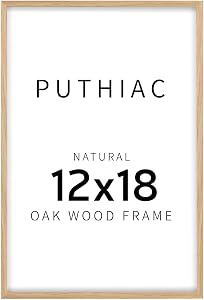 puthiac 12×18 in solid oak picture frame, natural oak (paid link). Pale oak with clean lines for the Scandinavian look; it fits a 12×18″ print without the mat.

What art suits Japandi, Scandinavian and wabi-sabi rooms?
Japandi rooms suit one large, calm piece with empty space around it. Scandinavian rooms often take graphic prints or botanicals, and wabi-sabi rooms suit rough ink and bare branches. Sumi-e-inspired ink work can sit in all three.
Brushed ink is everywhere in Japan, not only in galleries. I often see ensō-style brushed circles used as logos, even on food delivery trucks. In a Western room the same kind of mark reads as calm and graphic. That is why one ink piece can sit in a Japandi or a Scandinavian scheme.
Empty space is the thing to protect. In In Praise of Shadows (1933), the novelist Tanizaki Jun'ichirō wrote of the tokonoma: "An empty space is marked off with plain wood and plain walls" (quoted in the Stanford Encyclopedia of Philosophy). I hang one scroll in our tokonoma and change it over from time to time.
These are the prints I'd pick for each look. They start at US$34.99 for an 8×12″ on Fine Art paper and go up to US$129.99 for a 24×36″. The shop shows your own currency at checkout.
 The Crossing: a lone figure walks a low plank bridge out over still water, and the far end dissolves into mist. Black ink on warm cream, with most of the paper left empty, so it suits a Japandi hallway or living room. It works in a pale Scandinavian room too, because the cream ground is softer than white.
 Kakitsubata: a small stand of indigo-blue iris with their stems reflected in still water, on plain cream. Kakitsubata (Iris laevigata) is the water iris Ogata Kōrin painted on the famous gold Irises screens (燕子花図), a National Treasure at the Nezu Museum in Tokyo. It is the most Scandinavian-friendly print here: one clear note of blue, like a botanical, but with Japanese restraint.
 The Old Tree: a bare tree bent by years of wind, with a tiny figure beneath it, in raw black ink on warm cream. This is the wabi-sabi pick: worn by time and still standing.
 Snow Pine Branch: one pine branch in indigo and grey, its needles fading into mist, with most of the paper bare. It bridges Japandi and wabi-sabi.
Choose one and give it a whole wall. My framing guide explains which wood tones suit ink work, and the Japandi living room guide covers placement.
About the prints
These are sumi-e-inspired digital designs, finished in the studio, not hand-painted originals. They come in five upright sizes from 8×12″ to 24×36″, on Matte or Fine Art (archival) paper, and the 8×12″ comes on Fine Art only.
Printed to order in 2–5 business days by JONDO, our print partner, then usually 2–5 business days to the US and 1–5 to the UK, with tracking.
Frequently asked questions
Is Japandi just Scandinavian with Japanese decor? No. Japandi changes the base of the room as well: darker wood, lower furniture, warmer neutrals and fewer objects. Adding a Japanese vase to a white Scandinavian room gives you a Scandinavian room with a Japanese vase.
Is wabi-sabi a design style? Not really. Wabi-sabi is a Japanese way of seeing beauty in age, wear and imperfection. Designers borrow from it, and "wabi-sabi interiors" usually means rooms with raw, handmade and weathered materials.
Can you mix Japandi and wabi-sabi? Yes, and they mix easily. Keep the Japandi base of low furniture and warm neutrals, then add one or two old or handmade objects and art with rough, visible brushwork.
What colours are Japandi? Japandi colours are warm white, cream, sand and greige, with mid-to-dark wood such as oak or walnut. Add one or two muted accents like sage, clay, charcoal or soft indigo.
Who invented the word Japandi? Nobody agrees, and no one person is credited. The word appeared in the mid-2010s. The earliest documented use I could find is a December 2016 Daily Telegraph (Sydney) article, which quotes a designer who first heard the word around the Milan furniture fair earlier that year.
Related guides
- What is wabi-sabi art? Meaning, examples and how to use it at home
- The Japandi colour palette: a simple guide
- Dark Japandi bedroom: colours, ideas and the art that works
- Yūgen, ma and wabi-sabi: the Japanese aesthetics behind our prints
- Akari lamps and paper lanterns: how to light a Japandi room
Sources: Danish Architecture Center, "Japan and Scandinavia found each other long before we learned to call it Japandi", Anna Skovby Hansen, 3 Sep 2026 · Stockholmsmässan, "Material attraction – Scandinavia likes Japan" press release, 22 Oct 2013 · Daily Telegraph (Sydney), Robyn Willis, Japandi article, 2 Dec 2016 (archived) · Vogue, "'Japandi' Style Is The Minimalist, Multi-Cultural Interior Design Trend That Shows No Sign of Stopping", Elise Taylor, 31 Jul 2023, updated 26 Feb 2025 · Philadelphia Museum of Art, Northern Lights: Scandinavian Design · Jørn Guldberg, "'Scandinavian Design' as Discourse: The Exhibition Design in Scandinavia, 1954–57", Design Issues 27:2 (2011) · Design Forum Finland, Years 1951–1959 · VisitDenmark, What is hygge? · Collins, Top 10 Collins Words of the Year 2016 · Oxford Dictionaries, Word of the Year 2016 (archived) · Stanford Encyclopedia of Philosophy, "Japanese Aesthetics", Graham Parkes and Adam Loughnane, rev. 2023 · Kotobank, 南方録 · JAANUS, Nanbōroku · Leonard Koren, Wabi-Sabi: for Artists, Designers, Poets & Philosophers (1994) · Design Museum (London), A Century of Chairs: 1950s · Ministry of Foreign Affairs of Japan, Japan-Denmark Relations · Designmuseum Danmark, Learning from Japan · Nezu Museum, Irises by Ogata Kōrin · Kagiken flower-db, Iris laevigata and Iris ensata · Six Ancient Kilns, Tokoname · Google Ads Keyword Planner (average monthly searches, retrieved 14 Oct 2026)
About Yugen Print: Yugen Print's founder creates sumi-e-inspired Japandi and wabi-sabi art prints and splits her year between New Zealand and Japan. Yugen Print designs are sumi-e-inspired prints, not hand-painted originals, made to order on Matte or Fine Art (archival) paper. Read more about the studio.
As an Amazon Associate I earn from qualifying purchases. Links marked (paid link) go to Amazon.