The Five Japanese Principles Behind Every Print
31 May 2026


Five ideas, expressed in ink and empty space, the quiet grammar behind every Yugen Print piece.
There's a reason a sumi-e print feels different from other wall art. It isn't the subject, and it isn't the colour it's what's been left out, left unfinished, left to the imagination. Japanese aesthetics have spent centuries refining the art of saying more with less, and almost everything we make is built on five principles that predate the word "minimalism" by about a thousand years.
These aren't decorating rules. They're a way of seeing. Once you know them, you start to notice them everywhere and you understand why a single crane on an empty field can hold a room the way a wall of busy prints never will.
Here are the five, in plain language, with the pieces that carry each one.
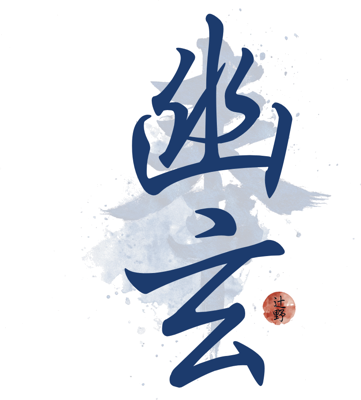
Yūgen (幽玄) — A Beauty Too Deep for Words
Yūgen is the hardest of the five to translate, which is fitting, because it's about the things that resist translation. It points to a profound, mysterious beauty, the feeling of watching the moon disappear behind cloud, or sensing the depth of a forest you can't quite see into. Not the beautiful thing itself, but the suggestion of something vast beyond it.
In ink, yūgen lives in atmosphere, mist, distance, the half-seen. It's why a temple dissolving into fog moves you more than a temple rendered in full detail. The fog is doing the work.
→ You'll find yūgen most in the Sacred Series pagodas and temples emerging from mist, designed to suggest rather than to state.
Ma (間) — The Power of Empty Space
Ma is the negative space, the pause, the gap, the silence between notes. In Western design, empty space is often something to fill. In Japanese aesthetics, it's the most important element on the page. The emptiness isn't absence; it's what gives the ink room to breathe and the eye somewhere to rest.
A single lotus against a wide expanse of still water isn't unfinished. The water is the point. Ma is the reason our prints leave so much of the cream paper untouched that openness is not blank, it's composed.
→ See ma at work in the Lotus & Moon Series, where a single bloom and a low moon are held in a field of quiet water.
Wabi-Sabi (侘寂) — Beauty in Imperfection
If you've read our journal before, you've met wabi-sabi: the beauty of the imperfect, the impermanent, the weathered. The crack in the bowl, the knot in the wood, the asymmetry of a hand-thrown vase. Wabi-sabi finds more presence in something worn and irregular than in anything flawless and machine-made.
Sumi-e is a wabi-sabi tradition by nature. In classical ink painting, ink on absorbent paper can't be fully controlled; it bleeds, pools, and feathers, and the slight irregularity of a stroke isn't a flaw to be corrected but the mark of a single moment. Our designs are drawn from that spirit: the gestural, imperfect character of brushed ink, where nothing is over-refined and everything that remains is essential.
→ Wabi-sabi runs through everything we make, but it's most visible in the bold, gestural ink style of the full collection.
Kanso (簡素) — Simplicity Through Elimination
Kanso is simplicity but not the empty, stripped-back kind. It's beauty achieved by removing the unnecessary until only the essential remains. Where minimalism can feel cold, kanso feels considered: every element that survives the editing earns its place.
In a print, kanso is the discipline of the single subject. One crane. One branch. One pine against snow. The restraint isn't a limitation it's the whole composition. Remove anything more and the piece would lose its meaning; add anything and it would lose its calm.
→ Kanso is clearest in the Crane Series a single bird, still water, and nothing that doesn't need to be there.
Mono no Aware (物の哀れ) — The Gentle Sadness of Things Passing
Mono no aware is the bittersweet awareness that nothing lasts and that things are beautiful because they don't. The cherry blossom is the national symbol of this feeling: adored not in spite of falling after a week, but because it falls. Its beauty and its brevity are the same thing.
This is the quiet emotional centre of Japanese aesthetics. A petal drifting onto still water carries a kind of tender melancholy that a permanent, unchanging image never could. To feel mono no aware is to be moved by impermanence rather than troubled by it.
→ No collection holds mono no aware like the Sakura Series cherry blossoms in bloom and in fall, beauty deepened by its own passing.
Why Our Prints Look the Way They Do
Put these five together and you have the whole quiet grammar of what we make. Yūgen gives a piece its depth. Ma gives it room to breathe. Wabi-sabi keeps the ink honest. Kanso strips it to the essential. Mono no aware gives it feeling.
It's also why a Yugen Print piece asks something different of a room. It isn't decoration to fill a gap on the wall it's a single anchor that the rest of the room can gather around quietly. One considered piece, alone on a wall, will always hold more presence than three competing for attention.
Less noise. More meaning. That's the entire idea, expressed in ink and in everything left empty.
→ Browse the full collection → Read: Shop the Wabi-Sabi Bedroom — Six Japandi Essentials Under $300