
Dark Japandi Bedroom: Colours, Ideas and the Art That Works
14 October 2026
This post contains affiliate links. As an Amazon Associate I earn from qualifying purchases at no extra cost to you.
Updated 14 October 2026 · By Yugen Print
Japandi is usually pictured in oat, sand and pale oak. But there is a quieter, deeper version of it, and it suits bedrooms better than almost any other room. Dark Japandi keeps everything that makes the style calm (restraint, natural materials, generous empty space) and simply turns the lights down. The result feels less like a showroom and more like a place to sleep.
This is a short guide to getting a dark Japandi bedroom right: the colours, the materials, the light, and the art that belongs on the wall.
What is a dark Japandi bedroom?
A dark Japandi bedroom uses the restraint of Japandi style with a deep, warm palette of charcoal, ink, walnut and earth instead of the usual pale neutrals.
The rules don't change. Furniture stays low and simple, every object earns its place, and empty space is treated as part of the design. What changes is the mood: darker walls absorb light rather than bouncing it around, so the room feels enclosed and restful, closer to a traditional Japanese room at dusk than a bright Scandinavian loft. It isn't hard to see why it's caught on: it's a calm look that doesn't feel cold.
What colours work in a dark Japandi bedroom?
Warm, deep, slightly muted colours work best: charcoal, ink black, walnut brown, clay, olive and deep indigo, softened with off-white linen.
The key word is warm. A cool, blue-grey black can make a bedroom feel like a cave; a charcoal with a brown or green undertone feels like wood smoke and night. Use one deep colour on the walls, a mid-tone in the wood, and a lighter, natural texture in the bedding so the room still has depth.
| Role in the room | Dark Japandi choice | Why it works | Avoid |
|---|---|---|---|
| Walls | Warm charcoal, soft black, deep olive or clay | Absorbs light and makes the room feel enclosed and restful | Cool blue-greys, glossy finishes |
| Wood | Walnut, smoked oak, charred timber (shou sugi ban) | Adds warmth against dark walls | Orange-toned pine, high-gloss lacquer |
| Textiles | Undyed or charcoal linen, wool, cotton | Texture stops a dark room feeling flat | Shiny synthetics, busy prints |
| Accent | Indigo, rust, muted sage | Quiet colour that stays in the same tonal family | Bright, saturated colour |
| Art | Indigo or black ink, warm cream ground, wide empty space | Echoes the palette without shouting | Busy gallery walls, high-contrast pop art |
For the lighter version of the palette, see our Japandi colour palette guide.
What furniture and materials suit a dark Japandi bedroom?
Low, solid, natural pieces suit it best: a low wooden bed frame, simple bedside tables and natural fibres throughout.
 Styled look
A low bed. A platform or low walnut frame keeps the room grounded and leaves more wall above it. AllForWood Thor solid wood Japanese joinery bed frame in walnut (or, for a splurge, the FLEXISPOT Hako G2 walnut joinery bed with headboard)
 Styled look
Linen bedding in layers. Charcoal, stone or undyed linen, a little rumpled, is the single most effective texture in a dark room. Simple&Opulence 100% linen duvet cover set in dark grey
 Styled look
One natural rug. Jute or wool softens the floor and adds a lighter tone underfoot. Loloi × Chris Loves Julia Judy natural jute rug
 Styled look
Simple bedside surfaces. A stump table or small wooden side table rather than matching sets. WELLAND natural tree stump side table
 Styled look
One vessel. A stoneware vase with a single dried branch is enough. weathered wabi-sabi ceramic vase in dark earthy tones
The aim is fewer, better things. If a piece doesn't help you rest, it probably doesn't belong. Our Wabi-Sabi Bedroom edit has more pieces in this spirit.
How should you light a dark Japandi bedroom?
Use low, warm, layered light, ideally paper lamps at around 2700K, and avoid bright overhead lighting.
Dark walls exaggerate harsh light, so the ceiling light should be the one you rarely use. A paper floor lantern in a corner and a small paper or linen-shaded lamp by the bed give a soft glow that makes dark colours look rich rather than gloomy. If you have a large print above the bed, a slim warm picture light turns it into the focal point of the room at night.
 Styled look
 Styled look


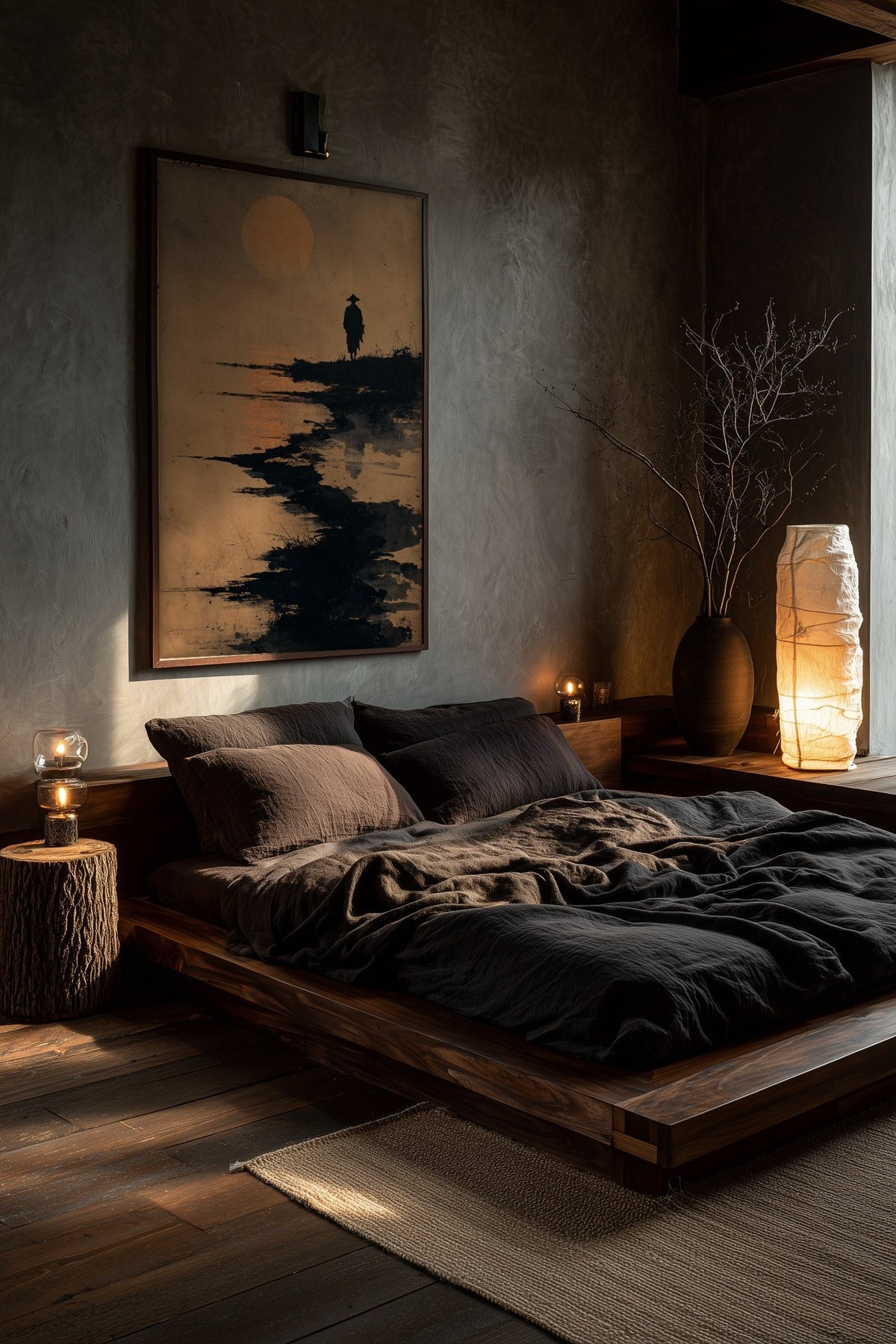
The Ronin's Moon above a low walnut bed. Shop The Ronin's Moon.
What art works in a dark Japandi bedroom?
One large, quiet piece in ink tones, a single subject with plenty of empty space, works best above a dark Japandi bed.
Night scenes and deep indigo ink suit the palette naturally, while black ink on warm cream ground gives a softer contrast that lifts a charcoal wall. Avoid gallery walls of small frames: on a dark wall they read as clutter. These four prints were made for exactly this kind of room:
 Moonlit Reeds: tall reeds against a low full moon, doubled in still water, in deep indigo ink. Its dark field is yohaku-no-bi, the beauty of the unpainted, so it blends into a dark wall rather than fighting it.
 The Night Crane: one crane, one moon, one reflection. A study in kanso (simplicity) and a calm anchor above a bed. In Japanese art the crane is also a symbol of long life and fidelity, which makes it a natural bedroom subject.
 The Crossing: a lone figure walks a plank bridge into mist, in black ink on warm cream ground. On a charcoal wall the pale ground glows softly, especially under a warm picture light. Its sister piece, The Crossing: Solitary Figure beneath Flowering Branch, works the same way in soft charcoal and sepia.
 The Ronin's Moon: a lone ronin in a straw hat pauses on a grassy bank as an amber moon hangs low over the water, in black sumi ink on a warm parchment-toned ground. A ronin was a samurai with no master, and the single figure in all that empty space makes it a quiet, contemplative piece. Above a low platform bed, the amber moon brings a touch of warmth to a charcoal wall.
| Ink and ground | Best wall colour | Mood | Best size above a double/queen bed | |
|---|---|---|---|---|
| Moonlit Reeds | Deep indigo, dark field | Charcoal, olive, indigo | Night, stillness | 24×36″ |
| The Night Crane | Deep indigo, dark field | Charcoal, soft black, clay | Simple, contemplative | 20×30″ or 24×36″ |
| The Crossing | Black ink on warm cream | Charcoal, walnut panelling | Soft contrast, hopeful | 24×36″ |
| The Ronin's Moon | Black ink and amber moon on a warm parchment-toned ground | Charcoal, soft black, walnut panelling | Solitary, warm | 24×36″ |
All four are printed to order on archival matte paper in sizes from 8×12″ to 24×36″. They're sumi-e-inspired prints, not hand-painted originals, and we're always clear about that.
How big should art be above a bed?
Aim for art that is roughly two-thirds the width of the bed, with the bottom edge 15–25 cm (6–10 in) above the headboard.
For a queen or UK king bed, that usually means a 24×36″ print, framed. A single piece of that size feels calm and deliberate; a small print floating on a big dark wall looks lost. Our guide to what size wall art to hang above a bed or sofa has the full size chart.
What frame suits a dark Japandi bedroom?
A walnut or matte black wooden frame suits it best, ideally with a mount or wide white border to give the art breathing room.
Walnut keeps a dark room warm; matte black disappears into a charcoal wall and lets the image float. Skip glossy or metallic frames. See how to frame and style a Japanese sumi-e print for more detail.
 Styled look
 Styled look
Frequently asked questions
Is dark Japandi still Japandi? Yes. Dark Japandi keeps Japandi's restraint, natural materials and empty space and only changes the palette, swapping pale neutrals for charcoal, walnut and ink.
Will a dark bedroom make the room feel smaller? Slightly, but in a bedroom that is usually a good thing: dark walls blur the corners and make the room feel enclosed and restful. Keep the floor and bedding lighter to balance it.
What's the difference between dark Japandi and wabi-sabi? Japandi is a design style blending Japanese and Scandinavian minimalism; wabi-sabi is the older Japanese idea of beauty in imperfection and impermanence. A dark Japandi room often borrows wabi-sabi textures like raw wood, rumpled linen and handmade ceramics. Our guide to the Japanese aesthetics behind our prints explains more.
Should art in a dark bedroom be dark too? Not necessarily. Indigo night scenes blend into a dark wall for a subtle, tonal look, while black ink on cream paper creates a soft contrast that becomes the focal point. Both work; pick one approach and keep to it.
How many pieces of art should go in a dark Japandi bedroom? Usually one large piece above the bed, plus at most one small piece elsewhere. Restraint is the point.
What lighting colour temperature is best? Warm white around 2700K. Cooler light makes charcoal walls look grey and flat.
Related guides
- The Japandi Colour Palette
- Shop the Wabi-Sabi Bedroom: Six Japandi Essentials Under $300
- What Size Wall Art for Above a Bed or Sofa
- How to Frame & Style a Japanese Sumi-e Ink Print
- What Wall Art Suits a Japandi Living Room?
This post contains affiliate links. As an Amazon Associate I earn from qualifying purchases at no extra cost to you.
About the author: Yugen Print is a small studio making Japandi and wabi-sabi art prints inspired by sumi-e ink painting, shaped by the Japanese ideas of wabi-sabi, ma and yūgen. Every print is made to order on archival matte paper and shipped to the US, UK, EU, Australia and New Zealand. Read more about the studio.