Sumi-e vs. Ukiyo-e: A Guide to Japanese Art Styles
16 August 2026


Two of the most recognisable Japanese art traditions look almost nothing alike.
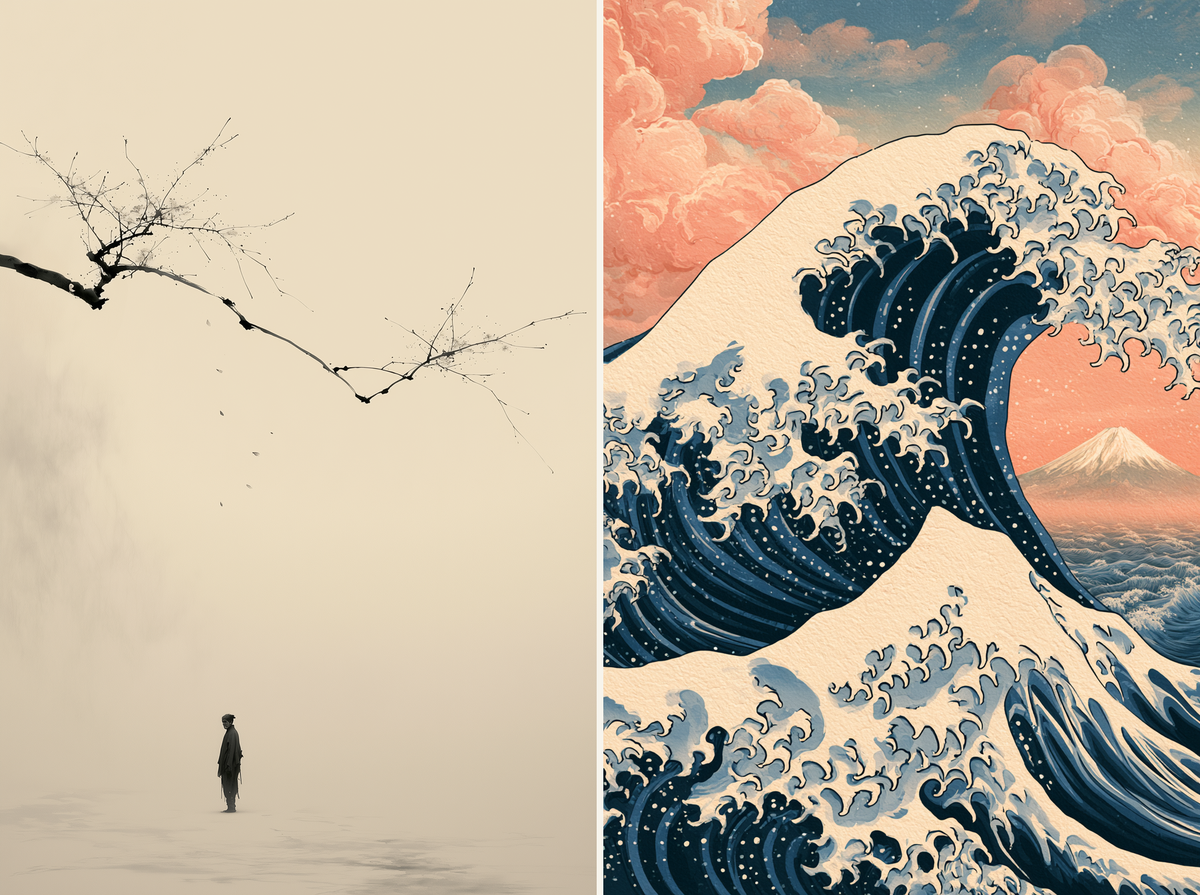
One is a single black brushstroke on empty paper: a mountain implied in three marks, a bird suggested rather than drawn. The other is a wave the height of a building, carved into wood and printed in deep Prussian blue, crowded with foam and motion.
Both are unmistakably Japanese. Neither is the other. If you've ever stood in front of a piece of "Japanese art" and not quite known what you were looking at, this is the guide.
What is sumi-e?
Sumi-e (墨絵) is Japanese ink wash art: black ink, water, and paper, and almost nothing else. It arrived in Japan from China around the 14th century, carried by Zen Buddhist monks, and its whole philosophy is subtraction. A sumi-e artist tries to capture the essence of a subject in the fewest possible strokes, leaving the empty space around it to do as much work as the ink itself. Mist, stillness, restraint.
What is ukiyo-e?
Ukiyo-e (浮世絵) means "pictures of the floating world." It flourished in the Edo period (roughly the 17th to 19th centuries) and is best known as a woodblock printing tradition: a design carved into wooden blocks, then printed in layers of colour, often in large editions. Its subjects were the pleasures of city life: kabuki actors, famous beauties, travel landscapes. Hokusai's Great Wave and Hiroshige's road scenes are ukiyo-e.
What's the difference between sumi-e and ukiyo-e?
The short version: sumi-e is monochrome ink applied by brush, prizing empty space and restraint; ukiyo-e is a colourful woodblock print, prizing detail, pattern, and scenes of everyday life. Sumi-e is one artist and one brush chasing an essence. Ukiyo-e is a workshop (an artist, a carver, and a printer) producing many copies of a bold, finished picture. One whispers; the other performs.
The two pull apart in a few clear ways. Sumi-e is built on black ink and its grey dilutions, with colour used rarely if at all. Ukiyo-e is defined by colour, laid down in flat, confident blocks from separate carved blocks. Sumi-e is drawn directly, brush to paper, in a single gesture that can't be repeated, while ukiyo-e is printed, a reproducible medium closer in spirit to publishing than to a one-off picture.
They also tend toward different subjects. Sumi-e favours landscape, nature, and Zen themes such as bamboo, mountains, or a lone figure in fog. Ukiyo-e documents a whole world of theatre, fashion, and travel. And where sumi-e treats the unmarked paper as part of the composition, chosen and weighted rather than left over, ukiyo-e usually fills its frame edge to edge.
Where does nihonga fit in?
You'll sometimes see a third term, nihonga (日本画), and it causes confusion. Nihonga isn't ancient. It's a label coined in the late 19th century to describe painting made with traditional Japanese materials (mineral pigments, washi paper, silk) as a deliberate counterpart to Western-style oil painting. So sumi-e is one narrow, ink-only tradition; ukiyo-e is a printmaking tradition; nihonga is a broad modern category of paintings made the traditional way. Different things, often shelved together.
Is sumi-e the same as calligraphy?
They're relatives, not twins. Both use the same ink, brush, and paper, and both value the quality of a single confident stroke. But calligraphy (shodō) renders characters and words, while sumi-e renders images: a landscape, a plant, an animal. The disciplines share tools and a spirit of restraint; what they make is different.
Which style suits your wall?
This is really a question about the room. Sumi-e-style ink art is quiet. It settles a space rather than fills it, and it suits calm, pared-back interiors: Japandi, wabi-sabi, minimalist, a meditation corner, a bedroom that wants to breathe. A bold ukiyo-e reproduction does the opposite. It's a colour statement and a focal point, at home in a room that can carry a strong graphic image. If your instinct is toward negative space, warm neutrals, and stillness, you're looking for ink.
A note on what we make
Everything at Yugen Print is drawn in the spirit of sumi-e: ink, mist, and the eloquence of empty space, rather than in either tradition literally. Each piece is printed to order on archival matte paper. They are original Yugen Print designs, not woodblock prints and not hand-painted brush originals. What draws people to sumi-e is the feeling, the restraint and the room to breathe, and that's what we build every piece around.