
How High Should You Hang Art? Heights and Sizes for Above a Bed or Sofa
16 August 2026
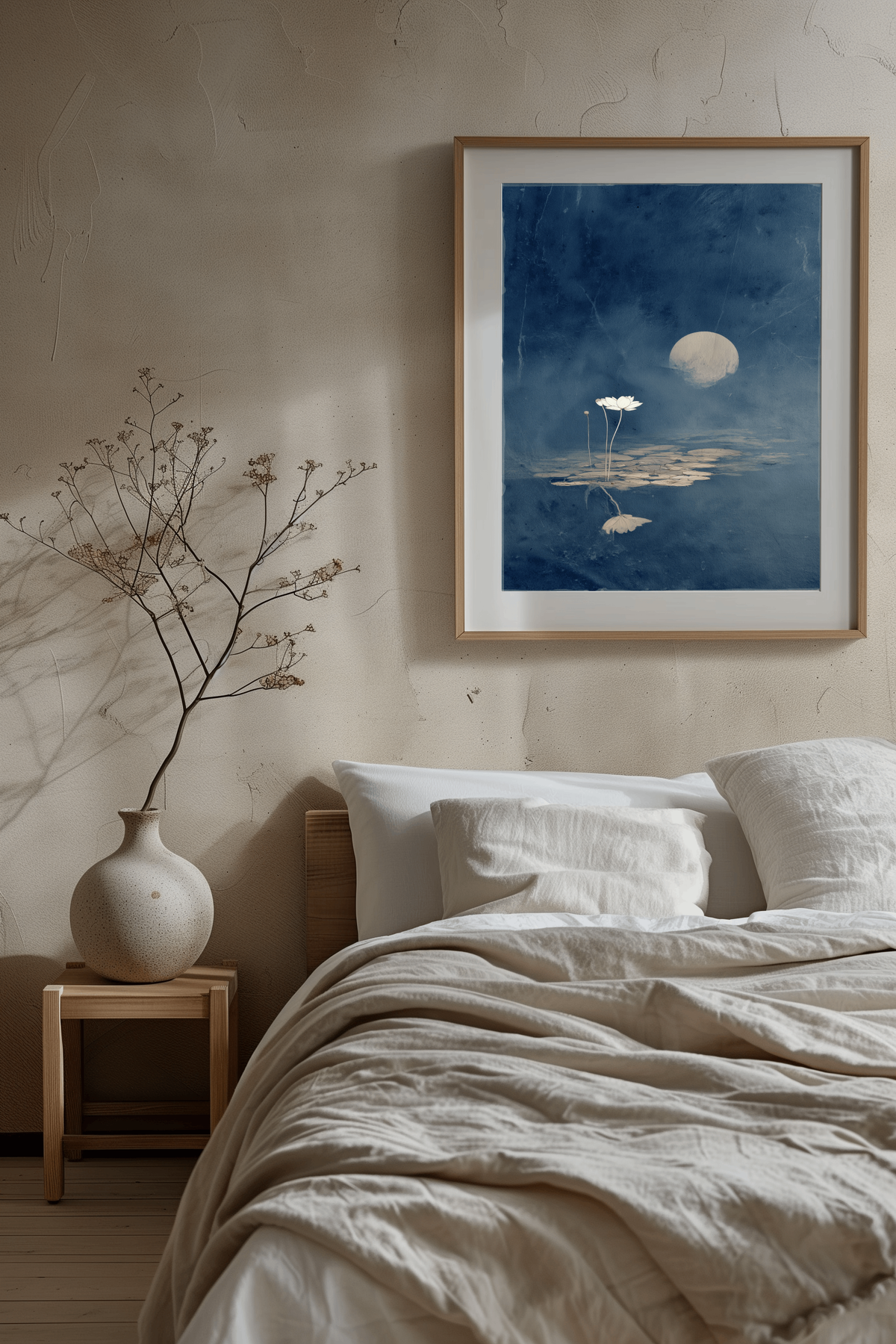
Links marked (paid link) go to Amazon, and I earn a commission if you buy through them, at no extra cost to you. As an Amazon Associate I earn from qualifying purchases. Links to my own prints are just my shop.
By Yugen Print · First published 16 August 2026 · Updated 18 October 2026: added hanging heights, a combined size table and advice for low ceilings and earthquake zones
Hang a single piece of art so its centre sits 145 to 152 cm (57 to 60 in) from the floor. Above a sofa or bed, ignore that and keep the bottom of the frame 15 to 25 cm (6 to 10 in) above the furniture instead.
I create sumi-e-inspired art prints, made to order, and I split my year between New Zealand and Japan. At home I tend to hang my own prints a little lower than the gallery rule, because most of the time I'm looking at them from a chair or from the floor. Both countries have earthquakes and Japan has low ceilings, so I've included what changes when a big frame goes over a bed in either place.
How high should you hang art on a bare wall?
On a wall with no furniture under it, hang art so the middle of the picture is 145 to 152 cm (57 to 60 in) from the floor. That's roughly the eye level of a standing adult.
Galleries don't agree to the inch. Park West Gallery uses 57 inches, and the preparator at the Weisman Art Museum says most works there go "58 on center". The preparator at McMaster Museum of Art, Jennifer Petteplace, adds a useful caution: the gallery standard "is intended for gallery viewers who are standing up, not at home" (McMaster Museum of Art). In a room where people mostly sit, she says the art should relate to the chairs.
To find your nail height, measure the frame's height and halve it. Add that to 145 cm, then subtract the distance between the top of the frame and the taut wire or D-ring. A framed 24×36″ print is about 97 cm tall with a slim frame, so its top edge lands at about 193 cm.
Before I hang a new print, I tape a sheet of paper the same size to the wall and live with it for a day or two. More than once it has shown me I was about to hang something too high.
How high should art hang above a sofa?
Keep the bottom edge of the frame 15 to 25 cm (6 to 10 in) above the top of the sofa back. Any higher and the art looks cut loose from the furniture.
Designers quoted in Architectural Digest and Apartment Therapy land in the same place: about 6 to 8 inches over a console, a little more over a sofa, and no more than 8 to 10 inches above furniture. "Most clients hang their pieces way too high," designer Ness tells AD.
When I'm placing a print above a sofa, I sit on the sofa before I pick up the drill. If I have to tip my head back to see the picture, it's too high, so I bring it down until it looks connected to the cushions.
For example, say your sofa back is 85 cm high and you leave a 20 cm gap. The bottom of the frame sits at 105 cm, and a framed 24×36″ print (97 cm tall) puts its centre at about 153 cm. Over a typical sofa, the two rules give almost the same answer.
How high should art hang above a bed?
Hang art 15 to 25 cm (6 to 10 in) above the headboard, centred on the bed. If you live somewhere with earthquakes, use a light, glass-free frame and secure hooks, or keep the wall over the bed clear.
New Zealand's National Emergency Management Agency advises hanging heavy pictures and mirrors "away from beds, couches, and anywhere people sleep or sit" (NEMA). The Natural Hazards Commission Toka Tū Ake says a frame on a single nail or thumbtack can easily fall in shaking, and suggests closed or latching picture hooks (Toka Tū Ake).
Over a bed I keep things light: a paper print in a slim frame with acrylic, never glass, on hooks that close over the wire. Earthquakes are part of life in both the countries I call home, and I'd rather give up a bit of wall than worry about what's above the pillows. Paper prints help here: an unframed or acrylic-glazed print weighs far less than a glass-fronted frame.
If you do hang over a bed, two easy changes lower the risk:
 Styled look
Swap glass for a light, shatter-resistant front. clear-fronted solid oak 24×36″ frame, with a lightweight plastic front instead of glass (no mount) (paid link)
Styled look
Swap glass for a light, shatter-resistant front. clear-fronted solid oak 24×36″ frame, with a lightweight plastic front instead of glass (no mount) (paid link) Styled look
Use a hook that traps the wire, not a single nail. Screw it into a stud where you can. anti-fall picture hooks that lock the hanging wire in place (4 per pack) (paid link)
Styled look
Use a hook that traps the wire, not a single nail. Screw it into a stud where you can. anti-fall picture hooks that lock the hanging wire in place (4 per pack) (paid link)
What size art should go above a bed or sofa?
Above a sofa, aim for art about two-thirds to three-quarters of the sofa's width. Above a bed, anything from half to three-quarters of the mattress width works.
Most of my designs are portrait, 2:3 prints, and that changes the maths. A single 24×36″ print is only 61 cm (24 in) wide, which is 40% of a 152 cm queen mattress. That's why the table below often suggests a pair or a row of three. The totals include a slim 2.5 cm (1 in) frame on every side and a 7.5 cm (3 in) gap between frames, so measure your own frames before you drill.
| Furniture (width) | Target art width | Combinations that fit (framed) |
|---|---|---|
| UK double bed (135 cm / 53 in) | 68 to 101 cm (27 to 40 in) | Two 16×24″ (99 cm), or one 24×36″ with a 5 cm (2 in) mount (76 cm) |
| UK king bed (150 cm / 59 in) | 75 to 113 cm (30 to 44 in) | Two 16×24″ (99 cm) |
| US queen bed (60 in / 152 cm) | 30 to 45 in (76 to 114 cm) | Two 16×24″ (39 in), or one 24×36″ with a 2 in mount (30 in) |
| UK super king bed (180 cm / 71 in) | 90 to 135 cm (35 to 53 in) | Two 20×30″ (119 cm), or three 12×18″ (122 cm) |
| US king bed (76 in / 193 cm) | 38 to 57 in (97 to 145 cm) | Two 20×30″ (47 in), or three 12×18″ (48 in) |
| Sofa 183 cm (72 in) | 122 to 137 cm (48 to 54 in) | Three 12×18″ (122 cm), or two 20×30″ with a 10 cm (4 in) gap (122 cm) |
| Sofa 213 cm (84 in) | 142 to 160 cm (56 to 63 in) | Three 16×24″ (152 cm) |
| Sofa 244 cm (96 in) | 163 to 183 cm (64 to 72 in) | Three 20×30″ (183 cm) |
Mattress widths are the standard sizes listed by Which? for the UK and Casper for the US. A headboard that's wider than the mattress counts too, so measure it.
Print sizes in this table run from 12×18″ to 24×36″, all in a 2:3 ratio. My prints come on Matte (200 gsm) or archival Fine Art paper (285 gsm), from 8×12″ to 24×36″ (the 8×12″ size is Fine Art only). A few older designs are still moving over to these papers, so check the options on each print's page.
One large piece or a set of two or three?
One large print gives the room a single focal point. A set covers a wide sofa or bed without needing one huge frame. Either works, as long as the total width lands in the range above.
My own sales lean large: two of the first eight prints customers bought from Yugen Print were 24×36″, The Crossing and Kakitsubata. A tall single print like these, or One Lantern, suits a narrow wall, the space beside a bed, or above a single bed or bench, where a 24×36″ print's 61 cm width is already close to two-thirds.
For a set, McMaster's preparator suggests making the gap a number that divides evenly into the width of each piece. "16 inch panels look best with 2, 4 or 8 inches between them," she writes. Lay the frames on the floor first, measure the whole group, then treat it as one shape when you work out the height.
A pair from the same series reads as one piece from across a room. Moonlit Reeds and One Lantern are both indigo night scenes, so they sit well side by side over a queen bed at 16×24″.
 One Lantern: a single paper lantern resting on still, dark water. At 24×36″ it holds a narrow wall on its own, and at 16×24″ it makes half of a pair.
 The Crossing: a lone figure sits by the water beneath a flowering branch, with almost everything else left empty. Customers have chosen this one at 24×36″.
 Kakitsubata: indigo irises at the water's edge on warm cream paper. Its tall stems suit the space beside a bed or above a bench.
 Moonlit Reeds: reeds against a full moon in deep indigo. Pair it with One Lantern over a queen bed.
What changes in a room with low ceilings or floor seating?
In a low room, hang art lower and choose shorter pieces. If people sit on the floor, bring the centre of the art down towards their seated eye level.
Most Japanese homes have 2.4 m ceilings, and the legal minimum for a habitable room is 2.1 m (Panasonic Homes). When people mostly sat on tatami, ceilings of about 2.2 m were common (TBS Housing).
In practice, put a framed 24×36″ print 20 cm above a 110 cm headboard and its top edge reaches about 227 cm, only 13 cm below a 2.4 m ceiling. Two framed 16×24″ prints side by side top out at about 196 cm in the same spot, which looks far more comfortable.
Japan has taught me to think smaller. In a low room, a pair of modest prints, or one hung low enough to see from a cushion on the floor, usually sits better than a single large frame.
How do you hang a large print without damaging the wall?
For a frame up to 24×36″ and under about 6.8 kg (15 lb), removable adhesive strips will hold it. For anything heavier, or anything over a bed or sofa in an earthquake zone, use closed picture hooks or screws into a stud.
The maker of the best-known removable strips says four pairs of its large picture-hanging strips hold 15 lb, with a maximum frame size of 24×36″ (maker's product page). So a 24×36″ print is right at the limit, and a glass-fronted frame that size can go over 15 lb. Weigh yours on a bathroom scale before you trust strips with it.
On my own walls I use closed picture hooks for anything framed, and save adhesive strips for small, light pieces in spots where I might want to move things around later.
What I'd use (I haven't tested these particular listings myself):
 Styled look
 Styled look
self-levelling green cross-line laser level (paid link)
Styled look
self-levelling green cross-line laser level (paid link) Styled look
 Styled look
clear-fronted solid oak 16×24″ frame, shatter-resistant (no glass) (paid link). It's sold singly, so order two for a pair, and leave out the mount to fit a 16×24″ print.
Styled look
clear-fronted solid oak 16×24″ frame, shatter-resistant (no glass) (paid link). It's sold singly, so order two for a pair, and leave out the mount to fit a 16×24″ print.
If you can, hang from two D-rings instead of a single wire. Petteplace says two hanging points keep a picture straight and help it "withstand vibrations from a passing bus", which is good advice in a city or on a fault line.
Quick reference
| Situation | Rule |
|---|---|
| Bare wall | Centre at 145 to 152 cm (57 to 60 in) from the floor |
| Above a sofa | Bottom of frame 15 to 25 cm (6 to 10 in) above the sofa back |
| Above a bed | Bottom of frame 15 to 25 cm above the headboard, centred on the bed; light frame and secure hooks in quake zones |
| Width above a sofa | Two-thirds to three-quarters of the sofa width |
| Width above a bed | Half to three-quarters of the mattress width |
| Floor-seated or low room | Hang lower; choose shorter pieces or a pair |
| Adhesive strips | Frames up to 24×36″ and 15 lb (four pairs of large strips) |
Frequently asked questions
Should art be centred on the wall or on the furniture? Centre it on the furniture below it. If the sofa or bed is off-centre on the wall, the art follows the furniture.
Is 57 inches or 60 inches right? Either works. Galleries use 57 or 58 inches to the centre, while the designer quoted in Apartment Therapy uses 60 inches for living rooms and bedrooms.
Can art be wider than the sofa? A gallery wall can run wider than the sofa, but a single piece or a pair usually looks best inside the sofa's width.
Can I hang art over a bed in an earthquake zone? New Zealand's emergency agency advises keeping heavy pictures away from beds. If you do hang one, choose a light frame with acrylic, and use closed or latching hooks.
Related guides
- How to Frame & Style a Japanese Sumi-e Ink Print
- What Wall Art Suits a Japandi Living Room?
- Dark Japandi Bedroom: Colours, Ideas and the Art That Works
- Akari Lamps and Paper Lanterns: How to Light a Japandi Room (and Your Art)
- Shop the Wabi-Sabi Bedroom: Six Japandi Essentials Under $300
Sources: McMaster Museum of Art, "Hanging art at home? Tips from the Gallery Preparator" · Weisman Art Museum · Park West Gallery · Architectural Digest · Apartment Therapy · NEMA (NZ Civil Defence) · Natural Hazards Commission Toka Tū Ake · Panasonic Homes · TBS Housing · Picture-hanging strip maker's product page · Which? · Casper
As an Amazon Associate I earn from qualifying purchases. Links marked (paid link) go to Amazon.
About the author: Yugen Print is a small studio making Japandi and wabi-sabi art prints inspired by sumi-e ink painting, run by Beth Tsujino between New Zealand and Japan. Yugen Print designs are sumi-e-inspired prints, not hand-painted originals, made to order on Matte (200 gsm) or archival Fine Art paper (285 gsm), 8×12″ to 24×36″. Read more about the studio.